













Paid Services







Eclipse 2026: Learn The Dates Of Eclipses This Year!
Author: Vijay Pathak | Last Updated: Mon 15 Dec 2025 10:30:35 AM
Eclipse 2026: An eclipse occurs when a celestial body is completely or partially obscured by another body. An eclipse occurs when the light of a celestial body is obscured by another body's shadow, or when a celestial body is obscured by light.
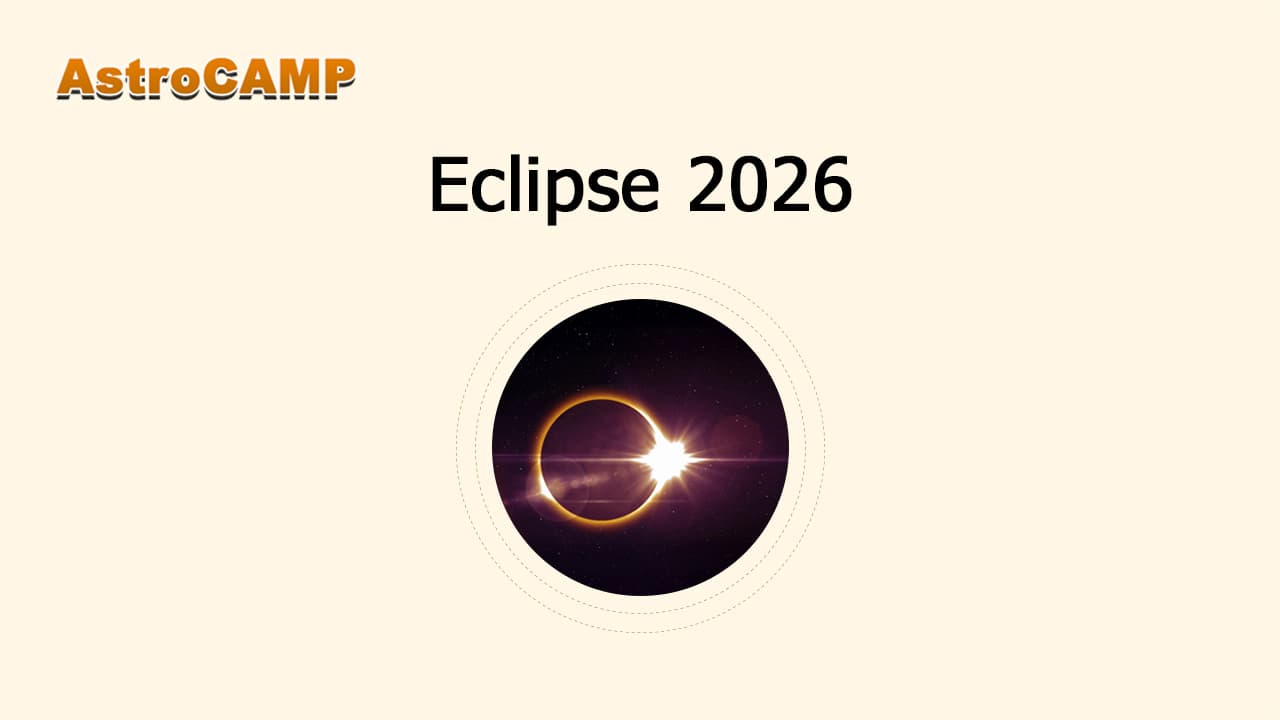
In the solar system, an eclipse occurs when the three celestial bodies—the Sun, Earth, and Moon—align in their orbits. Solar eclipses occur around the new moon, and lunar eclipses around the full moon. The Sun is the luminous body around which all the planets revolve. Since an eclipse means the temporary obstruction of a celestial body's light or radiance, eclipses occur only when the celestial bodies are at their peak power and brilliance.
Talk To Best Vedic Astrologers On Call & Know What’s In Store For
Eclipse 2026: According To Vedic Astrology
In Vedic astrology, Rahu and Ketu play a very important role. It is the time when they swallow the Sun (Surya Dev) and the Moon (Chandra Dev), and they become powerless. They are also known by their names "Dragon's Head" and "Dragon's Tail," which can be seen from their effects on the Sun or Moon during eclipses. We find the reference in the mythological story of Samudra Manthan. based on Hindu legends from the Vedic scriptures. As it happens, "Samudra Manthan" has something to do with the eclipse of the sun and moon. When the sheer sagar was churned, a substance known as "Amrit" emerged; the Asuras took this Amrit. Lord Vishnu then assumed the form of "Mohini," a beautiful apsara, and attempted to placate and distract the asuras in order to achieve the Amrit. After obtaining the Amrit, Mohini went to the devas to show it to them. One of the Asur, Svarabhanu, comes and sits between the Devtas to receive a portion of the Amrit.
However, Surya (the Sun) and Chandra (the Moon) exposed Svarabhanu's originality as a "Asura" as opposed to a devta. Knowing this, Lord Vishnu grew furious and cut Svarabanu's head in two halves, referring to the head half as rahu and the remainder of the body as ketu. According to legend, Svarabanu is thought to be alive in these two parts because he drank a few drops of Amrit. According to this theory, Rahu uses the solar and lunar eclipses as a means of exacting retribution on "Surya" and "Chandra." In Hindu mythology, lunar and solar eclipses are therefore not considered lucky occurrences.
हिंदी में पढ़ने के लिए यहाँ क्लिक करें: ग्रहण 2026
Solar Eclipse
A solar eclipse occurs on the new moon day, when the sun is at its highest position. A solar eclipse occurs when the sun is partially or completely hidden behind the moon. For this type of eclipse to occur, the moon must come between the earth and the sun. This prevents people on earth from seeing the covered part of the sun. The following conditions must be met for a solar eclipse.
It should be Amavasya.
The longitude of the Moon should be near Rahu or Ketu.
The latitude of the Moon should be near zero.
A solar eclipse can only occur on a new moon day when the Moon is at its weakest (invisible) and the Sun is at its full strength and brightness. The Moon's latitude is close to zero and this will happen only when the Moon is on or near the ecliptic. It's a coincidence that the Sun and Moon have the same angular diameter. Therefore, the Moon can only cover the Sun for a few minutes. When the Moon is at its apogee, its angular size is slightly smaller than that of the Sun. At its apogee, the Moon is at its farthest distance from Earth, making it appear slightly smaller when viewed from Earth. There are three types of solar eclipses.
Total Solar Eclipse
When the Moon is closest to the Earth (Perigee), the Moon's disk is slightly larger than the Sun's and when viewed from Earth, it will completely cover the Sun's disk, which will appear to the observer as a total solar eclipse. This occurs when the angular size of the Moon at its closest position to the Earth is larger than that of the Sun and the line joining their centers intersects the Earth's surface.Since both the Earth and the Moon are rotating rapidly in their orbits, their intersection point also rapidly crosses the Earth's surface, forming a narrow band. In a total solar eclipse, this band is called the "path of totality," and in an annular solar eclipse, it is called the "path of annularity." It is never more than 300 km wide but can be thousands of km long. The region of total shadow is called the umbra. The speed of the Moon's shadow varies from 1,800 km to 8,000 km per hour, depending on its position. For this reason, a total solar eclipse cannot last more than 7.5 minutes at any given location.
Partial Solar Eclipse
A partial solar eclipse occurs when the Moon covers only part of the Sun. This is visible beyond the "path of totality." The partial shadow region is called the penumbra.
Annular Solar Eclipse
When the Moon is at its apogee and its angular size is slightly smaller than that of the Sun, the Moon appears as a dark image surrounded by a bright ring of sunlight during a solar eclipse. This phenomenon in the solar system is called an annular solar eclipse. A solar eclipse can only be seen from a part of the Earth where it is daytime. Therefore, a solar eclipse occurs only during the day.
The distance between the Sun and Earth is slowly increasing at a rate of 38 mm per year. This means that millions of years ago, during a total solar eclipse, the Moon would have completely covered the Sun, and no annular solar eclipse occurred at that time. Similarly, it appears that millions of years from now, there will be only annular solar eclipses, and no total solar eclipses. This hypothesis will only prove true if the Sun's angular distance does not change over time.
When Will Your Luck Shine? Raj Yoga Report Reveals It All!
The Lunar Eclipse
A lunar eclipse occurs on a full moon day when the Moon is at its full brightness, reflected by the Sun's rays. When the Earth is between the Sun and the Moon
Earth's shadow falls on the Moon's surface, a lunar eclipse occurs.The totality of the Earth's shadow on the Moon is called Umbra and the partial shadow is called Penumbra. At the Moon's position, the angular radius of the Earth's shadow is 2.5 times the Moon's angular diameter. For this reason, the maximum duration of a total lunar eclipse can be 1 hour 40 minutes. Lunar eclipse can also be total or partial depending on the position of the observer on Earth. Lunar eclipse can be seen only from the dark region of the Earth, i.e., where it is night, on the night of the full moon. Here too, the eclipses of the Moon, Rahu and Ketu should be close and the latitude of the Moon should also be zero.
Due to the inclination of the Moon's orbital plane to the ecliptic, eclipses do not occur on every full moon or new moon. If the Moon's orbital plane were parallel to the ecliptic, a solar or lunar eclipse would occur on every full moon and new moon, respectively. The Moon crosses the ecliptic twice in one revolution. On such occasions, the conditions for an eclipse are met. For an eclipse to occur, the Moon's latitude must be near zero, and its orbit must be near Rahu or Ketu. When the Moon's latitude is zero, it
It occurs naturally on the ecliptic. Rahu and Ketu are nothing more than the intersection points of the Sun and Moon's orbits. When the Moon is on the ecliptic near zero latitude, the orbits of Rahu and Ketu need not be close to the Moon's orbits, as these points of intersection also have orbital motion. When the Moon's latitude is zero, it is not necessary that an eclipse will occur, as the Moon's orbital position may or may not be the same as that of Rahu or Ketu. Therefore, due to its association with Rahu and Ketu, this eclipse event has its own place and significance in Hindu astrology.
The timing, duration, and circumstances of solar and lunar eclipses depend on the changing geometric positions of the Earth, Moon, and Sun. After an eclipse, when the Sun, Earth, and Moon return to approximately the same geometric positions, a similar eclipse occurs. The cycle of their return to the eclipsed position is called a saros. The duration of a lunar cycle is 223 lunar months (approximately 6585.3213 days or approximately 18 years 11.5 days). This can be used to determine future solar and lunar eclipses.
The lunar cycle should be understood from the perspective that it contains a significant component of 1/3 day, or approximately 8 hours, which has its own significance. As a result of the Earth's rotation on its axis for each successive lunar cycle, the next eclipse will occur 8 hours later. The region where the eclipse is visible will then shift approximately 120 degrees westward. Therefore, an eclipse visible from one location will not be visible from that location in the next lunar cycle. However, if one waits for three lunar cycles, the local time of the next eclipse will be the same. This will occur after approximately 54 years and 1 month, or approximately 19756 days. This cycle is known as the Triple Saros.
Eclipses in 2026
In the year 2026, the following three eclipses will be visible on the Earth:
(i) Annular Solar Eclipse (Feb. 17, 2026).
(ii) Khagras lunar eclipse (March 3, 2026).
(iii) Total solar eclipse (August 12, 2026).
(iv) Partial lunar eclipse (August 28, 2026).
First Solar Eclipse 2026 - Annular Solar Eclipse (IST)
|
Tithi |
Day and Date |
Solar Eclipse Start Time (IST) |
Solar Eclipse End Time |
Visibility Area |
|---|---|---|---|---|
|
New Moon of Phalguna Month |
Tuesday, February 17, 2026 |
3:26 PM |
7:58 PM |
South Africa, South America, the Pacific, Atlantic, Indian Ocean, and Antarctica. This eclipse will be visible in countries like Chile, Argentina, South Georgia, Malawi, Namibia, Norway, France, Zimbabwe, Mauritius, Madagascar, Tanzania, Zambia, etc. (This eclipse will not be visible in India.) |
(i) Annular Solar Eclipse (February 17, 2026 )
This eclipse will be visible in the form of an annular eclipse in various parts of the world on Falgun Krishna Ama, Tuesday, February 17, 2026, from 15:26 to 19:58 according to Indian Standard Time. This eclipse will be visible in the form of an annular eclipse in South Africa, South America, the Pacific, Atlantic, Indian Ocean and Antarctica. This eclipse will be visible in countries like Chile, Argentina, South Georgia, Malawi, Namibia, Norway, France, Zimbabwe, Mauritius, Madagascar, Tanzania, Zambia etc. This eclipse will not be visible in India.
|
Tithi |
Day and Date |
Solar Eclipse Start Time (IST) |
Solar Eclipse End Time |
Visibility Area |
|---|---|---|---|---|
|
New Moon of Shravan Month |
Wednesday, August 12, 2026 |
9:04 PM |
August 13, 2026, 1:57 AM |
Europe, North Asia, North-West Africa, most parts of North America and in the Pacific, Atlantic, and Arctic Oceans. most parts of Greenland, Iceland and Spain. But the same eclipse will be visible in partial form in Canada, Norway, some parts of Greenland, Iceland, Sweden, Poland, Denmark, Germany, Austria, Ireland, Netherlands, Italy, Cascadia, Slovenia, UK, Belgium, Luxembourg, France, Switzerland, Monaco, some parts of Spain, Algeria, Portugal and Morocco etc. ( This eclipse will not be visible anywhere in India. ) |
(ii) Total Solar Eclipse (August 12, 2026)
This eclipse will begin on Shravan Amavasya, Wednesday, August 12, 2026, at 21:04:15 PM according to Indian Statistical Institute and will end on August 13, 2026, at 1:57 AM. It will be visible in its total form in many parts of the world. This planet will be visible in Europe, North Asia, North-West Africa, most parts of North America and in the Pacific, Atlantic, and Arctic Oceans
It will be visible in total form in most parts of Greenland, Iceland and Spain. But the same eclipse will be visible in partial form in Canada, Norway, some parts of Greenland, Iceland, Sweden, Poland, Denmark, Germany, Austria, Ireland, Netherlands, Italy, Cascadia, Slovenia, UK, Belgium, Luxembourg, France, Switzerland, Monaco, some parts of Spain, Algeria, Portugal and Morocco etc. This eclipse will not be visible anywhere in India.
AstroSage Brihat Kundli : Get Accurate and Reliable Life Predictions
First Lunar Eclipse 2026: Total Lunar Eclipse 2026
|
Tithi |
Day and Date |
Lunar Eclipse Start Time (IST) |
Lunar Eclipse End Time |
Visibility Area |
|---|---|---|---|---|
|
Full Moon of Phalguna Month |
wednesday, March 3, 2026 |
3:20 PM |
6:47 PM |
Eastern Europe, Asia, Australia, North and South America, the Pacific, Atlantic, Arctic, Antarctic, and Indian Oceans, Cuba, Thailand, North Korea, Singapore, China, El Salvador, Japan, Mexico, Myanmar, and cities in eastern India. It will also be partially visible in Brazil, Argentina, parts of Canada, Chile, Venezuela, Bangladesh, Uzbekistan, and most of India. |
This total lunar eclipse will be visible on Falgun Purnima, Tuesday, March 3, 2026, from 3:20 PM to 6:47 PM in Eastern Europe, Asia, Australia, North and South America, the Pacific, Atlantic, Arctic, Antarctic, and Indian Oceans.It will be visible in totality in Cuba, Thailand, North Korea, Singapore, China, El Salvador, Japan, Mexico, Myanmar, and cities in eastern India. It will also be partially visible in Brazil, Argentina, parts of Canada, Chile, Venezuela, Bangladesh, Uzbekistan, and most of India.
This eclipse will start from 3:20 PM and end at 6:47 PM as per IST. Because this eclipse will be visible in India as a rising moon, the eclipse will be considered to have begun at moonrise in all regions. So in India, the eclipse time is from 6:26 PM to 6:47 PM.
Eclipse Sutak- The Sutak period of this eclipse will begin on March 3, 2026, at 6:20 AM.
Horoscope of Eclipse- This eclipse is occurring during Purva Phalguni Nakshatra and Leo zodiac sign, hence it will be more inauspicious and painful for the people born under Purva Phalguni Nakshatra and Leo zodiac sign.
Second Lunar Eclipse 2026: Partial Lunar Eclipse 2026
|
Tithi |
Day and Date |
Lunar Eclipse Start Time (IST) |
Lunar Eclipse End Time |
Visibility Area |
|---|---|---|---|---|
|
Full Moon of Shravan Month |
Friday, august 28, 2026 |
6:55 AM |
12:30 PM |
Europe, Western Asia, Africa, North-South America, Pacific, Atlantic, Antarctica and Indian Ocean. Hungary, Austria, Nigeria, Chile, partially visible in the Netherlands, France, Venezuela, Italy, Peru, Mexico, Canada, Belgium, Salvador, Portugal, Cuba, Morocco, South Africa, Ireland, the United States, Algeria, Spain, Brazil, England, Argentina, Guatemala, Germany, Dominican Republic, Croatia, Kazakhstan, etc. ( not be visible anywhere in India.) |
This eclipse will be visible in partial form in various countries of the world on Shravan Purnima, Friday, August 28, 2026, starting from 6:55 AM and continuing till 12:30 pm as per IST. This eclipse will be visible in Europe, Western Asia, Africa, North and South America, the Pacific, Atlantic, Antarctica and the Indian Ocean. This eclipse will be visible in Hungary, Austria, Nigeria, Chile, It will be partially visible in the Netherlands, France, Venezuela, Italy, Peru, Mexico, Canada, Belgium, Salvador, Portugal, Cuba, Morocco, South Africa, Ireland, the United States, Algeria, Spain, Brazil, England, Argentina, Guatemala, Germany, Dominican Republic, Croatia, Kazakhstan, etc. This eclipse will not be visible anywhere in India.
Career Related Doubts? Order Your Personalised Career Counseling CogniAstro Report Now?
The Sutak Period Of The Solar & Lunar Eclipse
Additionally, a significant question that comes up with the eclipse is when Sutak Kaal begins. To answer this question, we must first define Sutak. Simply put, sutak kaal is a sensitive time that is not auspicious and that begins a few hours before the eclipse. For instance, during a solar eclipse, it begins before four peher, which is twelve hours, and for a lunar eclipse, it begins before three peher, which is nine hours. This phrase is often used in the family during childbirth. We must abide by a number of customs and laws throughout this period.
Now the question arises why is this period considered inauspicious so scientifically seeking the during the eclipse time the life giving forces sun and moon gets week and due to that the impurities in the atmosphere increases and the negativity in the atmosphere also increase which could lead to low immunity of people, health issues, mental and emotional disturbance therefore it is advised not to consume anything during sutak kaal and grahan kaal not to do any other important work.
Chanting the mantra and practicing meditation are recommended to help you become safe from the negative effects of the eclipse. During sutak kaal, numerous additional safety measures must be followed. During the Sutak period, temples are closed, and it is also advisable that you close any places of worship or pooja.
Do And Don'ts during Eclipse and Sutak
Do not touch any sculptures of gods during the eclipse. After the Sutak period, you should bathe, change into new clothes, and wash the god statues with Gangajal before re-clothing them.
Take a Ganga River bath. If it is not feasible, you might add a few drops of Gangajal to your bath water.
Do not eat or drink anything during this time.
Oil massage, drinking water, combing hair, and brushing teeth are prohibited activities.
Young children and pregnant women require special attention.
Pregnant women are urged to avoid utilizing sharp or pointy things.
One must stay indoors and not start or continue any new activities or tasks.
Meditation and worship are beneficial and bring about mental serenity.
Because moon eclipses have a stronger effect on emotions and mental health, try to stay calm, happy, and at ease during Chandra Grahan.
Being furious and violent is discouraged.
Please maintain peace in your home.
It is preferable to remain celibate throughout this period.
Remedies to perform after the Eclipse
Ganga water should be used to cleanse the gods' idols and places of worship following the eclipse.
Following the eclipse, people are asked to wash with Gangajal and change into fresh, clean clothes. It is also anticipated that the devilish work done by the overshadowing will be washed away by sprinkling Ganga water or, if feasible, taking a holy bath in the Ganga.
After the eclipse is done, eat freshly prepared food.
Items can be donated to temples or to those in need following the eclipse.
Donations should be made in accordance with your zodiac sign. Additionally, you can repeat mantras in accordance with your zodiac sign's ruling lord.
Frequently Asked Questions
1. What should not be done during the Sutak and the eclipse period?
One should avoid violence and anger during this time.
2. When should we eat food on the day of an eclipse?
Once the eclipse is over, you should eat freshly cooked food.
3. When will the first lunar eclipse of 2026 occur?
On Wednesday, 03 March 2026.
Buy Quality Gemstones, Yantra, Astrology Services Online: Click Here
We hope that this article on Eclipse 2026 proves to be useful for you. May you have a happy and blessed year ahead!


 Buy Today
 Best quality gemstones with assurance of AstroCAMP.com More
 Take advantage of Yantra with assurance of AstroCAMP.com More
 Yantra to pacify planets and have a happy life .. get from AstroCAMP.com More
 Best quality Rudraksh with assurance of AstroCAMP.com More
Get your personalised horoscope based on your sign.